
Services
Functionality and effectiveness through optimal interaction.
Structure development is an extensive area of responsibility – from urban infrastructure through corporate structures to personal structures. My focus is to analyse and develop the Hard- and Soft-Facts© in organisations.

“Strengthening strengths is only half of the job. Detecting vulnerabilities and turning them into strength is the other half.”
- Structural advice at micro and macro level
- Concept & design for healthy growth and steady profit
- Solution advisor in complex programmes
01 Five areas
One organisational model, five perspectives.
01
Organisational Security
- Governance structures
- Risk, compliance and security frameworks
- IKS, audit, data protection, information security (ISMS, AIMS)
- Business Continuity Management (BCMS)
- Emergency & crisis management
- PQC, AI-related risks, technological resilience
- Protection of critical infrastructures
02
Resilience
- Structural and organisational resilience
- Robust processes and stable operations
- Crisis-readiness and scenario preparation
- Resilience architectures for volatile environments
03
Sustainability · CSR · ESG
- Sustainable corporate governance
- ESG frameworks and CSR strategies
- Sustainable organisational development
- Embedding sustainability into structures, processes and management systems
- Technology impacts on economy and society
04
Corporate & Structure Development
- Organisational design and process architecture
- Transformation & scaling
- Future-readiness & sustainable value creation
- Reduction of hidden costs, rework and waste
- Structural clarity in complex environments
05
Organ Structure Analysis
- Review for a holistic overview of the organisational interrelations of influence, and their effect by and on the governing bodies (Organschaft)
- Organ analysis: taking organisational and cultural aspects of governing bodies into account, and their impact on structures and the organisation
- Method / procedure (1): proprietary procedure for the risk-, potential- and impact-relevant analysis of organ structures
- Method / procedure (2): integrating cultural aspects into organisations and their impact on structure, e.g. preparing, integrating, implementing and carrying out a CSR, sustainability and ESG management system (German: unternehmerische Verantwortung und Nachhaltigkeit)
02 Thematic modules
Building blocks that fit together.
Combined depending on the starting point – from structure analysis to impact measurement.
| Module | Thematic focus | Description |
|---|---|---|
| Structure Development | Organisational design and structure | Development of stable, flexible structures for sustainable effectiveness |
| Integrative©Management Systems | Systemic control | Establishment and integration of CSR, ESG, QMS, TQM, ISMS, BCMS, risk & compliance, etc. |
| Emergency & Crisis Management | Resilience and security | Initial establishment or professionalisation of emergency and crisis preparedness and management |
| Corporate & Organizational Security | Corporate/security architecture | Protection of organisations from systemic risks |
| Governance & Strategy Development | Goal orientation and leadership | Development of strategic orientation and control systems |
| CSR, ESG and Sustainability | Future viability and responsibility | Establishment of sustainable concepts and social responsibility, sustainable profit generation |
| Efficiency & Profitability | Continuous improvement and cost-effectiveness | Automation and reduction of seepage costs, rework, waste |
| Culture and Values Development | Transformation & attitude | Promotion of corporate culture and value-based leadership |
| Smart City and Energy Transition | Future projects | Development of viable concepts for social transformation |
03 / Challenges
What organisations are working on today.
Increasing regulation
ties up resources and drives up costs
Lack of future viability
organisations must become more resilient and sustainable
Lack of overview and controllability
inefficient structures and processes
Vulnerability to crises
emergency and crisis management are often inadequately prepared
Complexity and lack of transparency
reduced through functional concepts and clear structures
04 / Changes
Where the journey leads.
Structural development
stable yet flexible organisational structures
Increased efficiency
automated processes for greater effectiveness and profitability
Resilience and security
increased resilience to crises
Functionality and effectiveness
improved processes and systems
Future viability
viable concepts, e.g. for energy transition and sustainability
The goal is the transformation into a state of functional stability and sustainable effectiveness.
05 Responsibility
From analysis to impact measurement.
1
Concept & analysis
Developing the overall functional concept and analysing the initial situation.
2
Structuring & design
Shaping organisational and systemic frameworks.
3
Support & implementation
Accompanying the implementation and ensuring effectiveness.
4
Evaluation & impact measurement
Measuring effects – through KPIs, satisfaction, resilience and controllability.
06 Presentation
Hard- and Soft-Facts© in organisations.
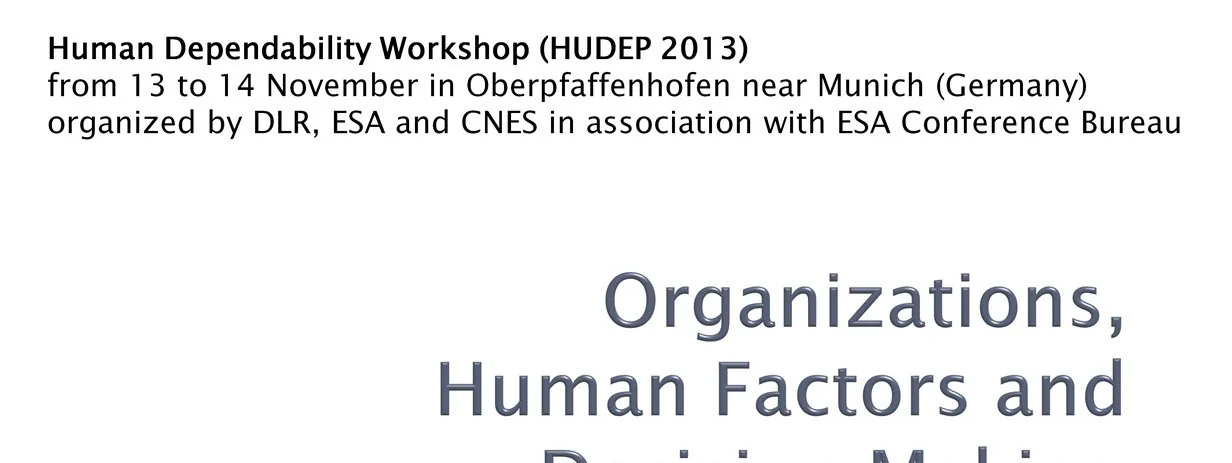
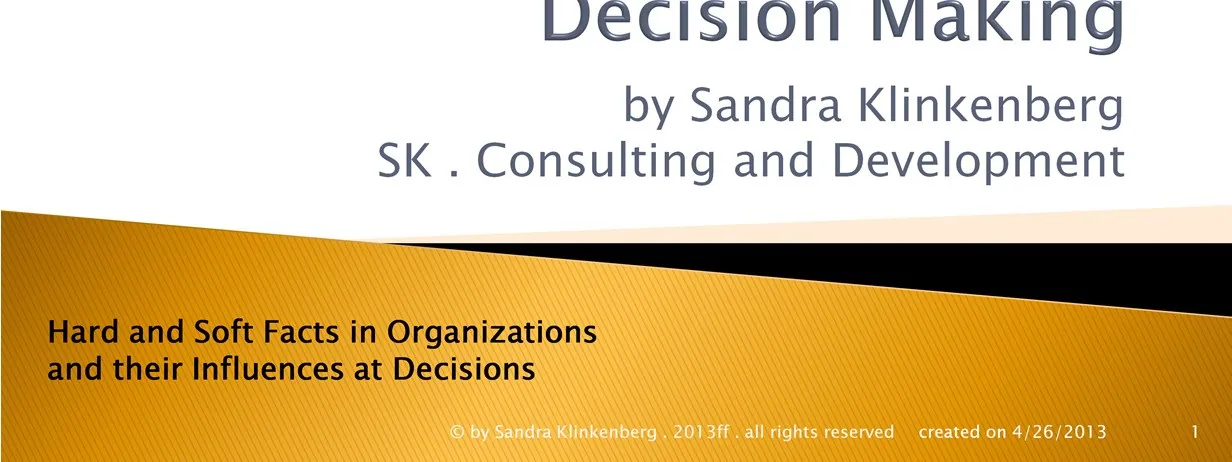
Why human decisions shape the structure and success of organisations: talk by Sandra Klinkenberg at the Human Dependability Workshop (HUDEP 2013) in Oberpfaffenhofen near Munich. Slides and speaker notes are in English.
Slide 1 of 14
Organizations, Human Factors and Decision Making
Speaker notes
Good morning. My name is Sandra Klinkenberg and I am thankful for the opportunity to speak here at HUDEP.
I will talk about hard and soft facts and its influencers on decisions and organization.
Let us start:
Which organizational influencers do you have?
Hard- and Soft-Facts© – Organizations, Human Factors and Decision Making
The complete presentation with slides and speaker notes to open and download.
PDF · 14 pages · English · HUDEP 2013
Next step
Clarity instead of busywork – let us talk.
Arrange your appointment simply by message. I will reply as soon as possible.