
Knowledge · Blackout
Blackout, emergency and crisis management.
Prevention, precaution, preparation: how organisations stay operational during power and infrastructure outages – and why business continuity is an in-house insurance policy.
01 Security of supply
Energy, grid and infrastructure.
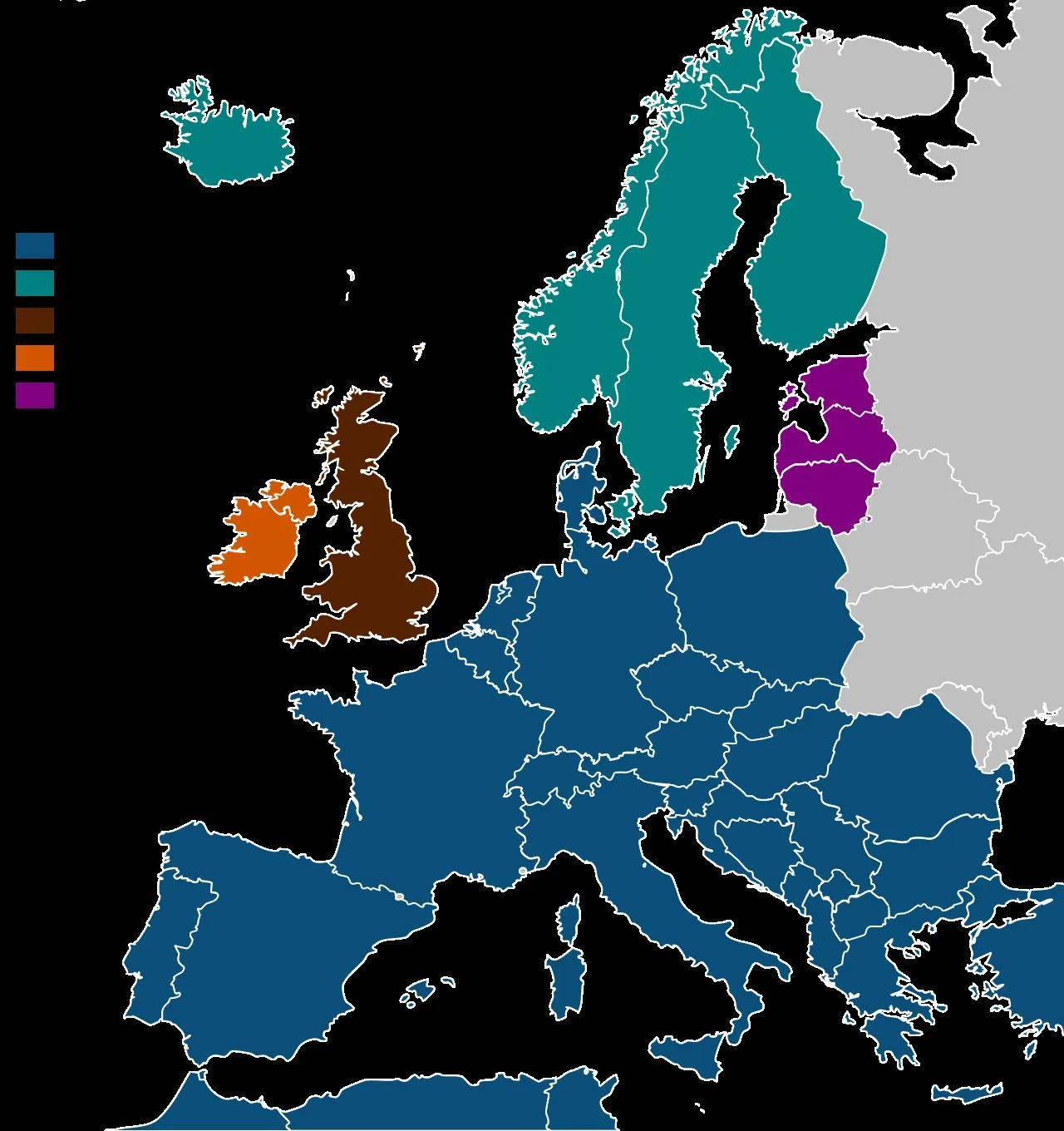
Germany is part of the European interconnected electricity grid – a purely national view falls well short. Energy sources can be fossil, nuclear or renewable; each is needed for generating electricity and heat.
Energy transition, security of supply, infrastructure, security, civil protection and disaster management belong together – and so does self-help. KRITIS (critical infrastructure) hazards are relevant not only for KRITIS organisations.
More on the situation: KRITIS hazard situations at the BBK · Requirements under Section 8a (5) BSIG (GAiN)
02 Talks
Insights from talks.
Blackout, brownout, power cuts and the growing importance of corporate emergency and crisis management – insights from talks and symposia.
03 Definitions
Disruption, emergency, crisis, disaster.
Within organisations there are no disasters, only emergencies and crises. A threat may escalate from a disruption to an emergency or a crisis – or trigger both straight away. Keeping these terms clearly apart determines who is responsible.
| Term | Definition | Areas, responsibility and regulations |
|---|---|---|
| Disruption | Short-term failure of processes or resources with only minor damage. It is handled as part of normal incident resolution. | IT / service management, incident management (minor and major incident and problem management) |
| Emergency | Prolonged failure of processes or resources with high or very high damage. It requires a dedicated emergency organisation. | Emergency organisation, emergency team, special organisation (BAO, special organisational structure), Business Continuity Management |
| Crisis | An aggravated emergency, essentially confined to the organisation, that threatens its existence or affects the health or lives of people. Crises do not affect the surrounding area on a broad scale and can, at least for the most part, be resolved within the organisation. | Crisis organisation, crisis team, special organisation (BAO), Business Continuity Management |
| Disaster | A major incident of damage that is not limited in space or time, for example as a result of floods or earthquakes. From an institution’s point of view it presents itself as a crisis and is managed internally by the emergency and crisis organisation in cooperation with external relief organisations. | Civil protection and external institutions, authorities, emergency services, the military and official assistance – they are authorised to use relevant sites and materials to manage it. |
04 Business Continuity
Business continuity as a safety net.
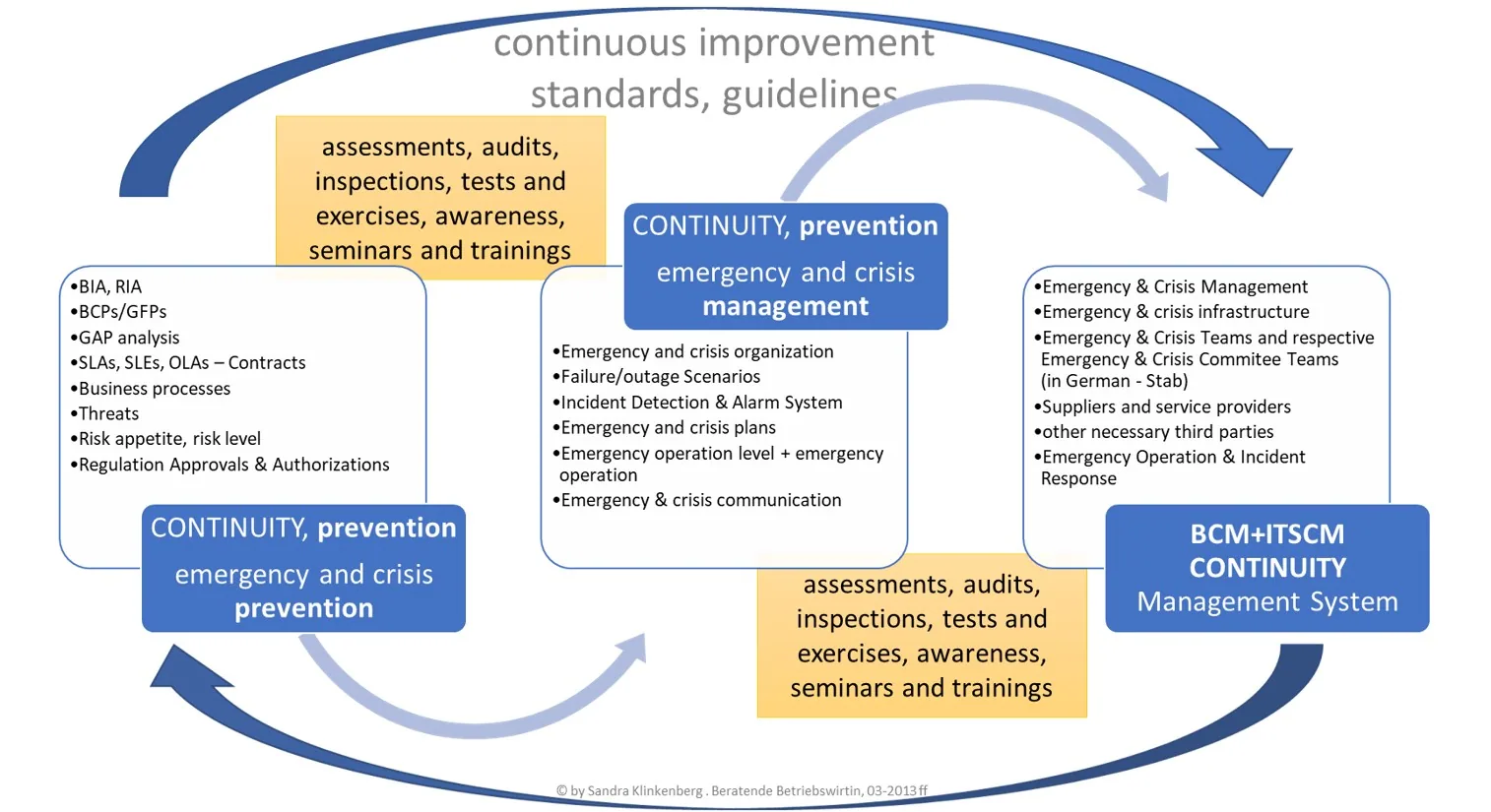
Business Continuity Management (BCM), more precisely business continuity management in the sense of keeping the business running, is a comprehensive management system. It prepares for emergencies and crises, rehearses the response and helps to return to normal operations quickly with minimal damage – and, in “peacetime”, to identify risks, opportunities and potential early on.
It consists of prevention (developing, testing and updating policies and measures) and response (the special organisational structure in an acute situation). It is usually based on the international standard ISO 22301; closely linked are risk management, information security management (ISMS) and the ICT infrastructure, for example in line with ISO/IEC 27031.
Key tools and resources
- Business Continuity Plans (BCPs) for each organisational unit and department
- Restart and recovery plans (RSPs and RHPs) for each zone, group, component or application
- Emergency and crisis plans for each zone, group, building, site or legal entity
They are developed, tested, reviewed and constantly updated in “peacetime” – so that in the event they are up to date, rehearsed and ready for immediate use.
05 Threats
Scenarios worth knowing.
Natural hazards
Fire, water, wind, natural disasters, explosions, terrorist attacks, loss of buildings, power cuts and energy outages, major incidents in the surrounding area, radiation
People and staff
Lockout, kidnapping, loss of staff, service providers or agents, identity theft, social engineering
IT, ICT and infrastructure
Theft, data loss, sabotage, espionage, cyber attacks such as malware and phishing, tampering, unauthorised access, destruction, failure, malfunction, misuse
Business operations
Disclosure of sensitive information, attacks and assaults, lack of resources, breaches of laws and regulations, coercion, blackmail, corruption, failure of goods, services and supplies
The Federal Office for Information Security (BSI) regularly provides up-to-date resources, such as the catalogue of elementary threats (as at 7 December 2020) – from fire and water and the failure of the electricity supply to the failure or disruption of communication networks.
06 Key figures
How much downtime is tolerable?
The business side defines what it needs. This is collected once a year in the Business Impact Analysis (BIA) and checked against the reality of the technical and organisational possibilities.
- RTO
- Target for the recovery time
- Recovery Time Objective
- RPO
- Target recovery point, i.e. the maximum tolerated data loss
- Recovery Point Objective
- MBCO
- Level of contingency operations
- Minimum Business Continuity Objective
- MTPD
- Maximum tolerable duration of the interruption
- Maximum Tolerable Period of Disruption
Trained staff are the guarantors of resilience: education, training, testing and exercises turn planned measures into confident, practised action.
07 Approach
How Business Continuity Planning works.
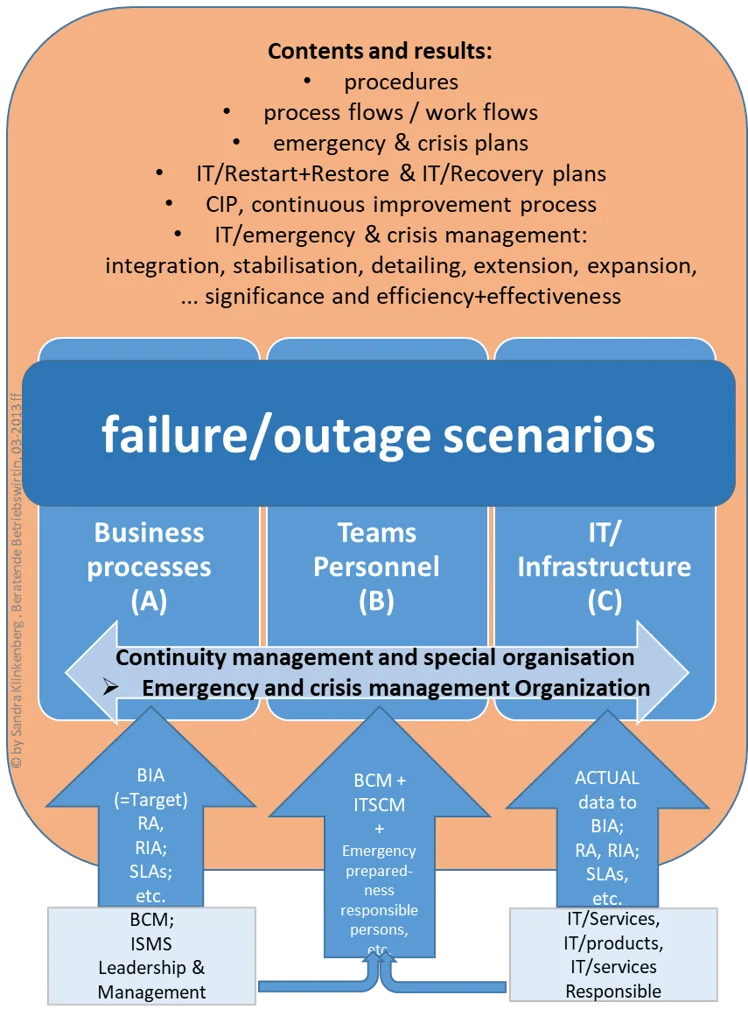
All information is brought together so that risk is reduced and a defined operational and business continuity capability is established:
- 01Business processes, mapped end to end (End2End), and the entire process landscape
- 02Infrastructure, such as sites and site plans
- 03Risk management, compliance, legislative monitoring, audit and internal audit
- 04ICT infrastructure and architecture, together with management processes
- 05Business Continuity Plans (BCPs)
- 06Restart and recovery plans (RSPs/RHPs), both on the IT side and in the business
- 07Emergency and crisis plans
- 08Comparison of target and actual state: gap analysis, risks, potentials and measures
- 09Teams and staff: emergency and crisis teams, staff teams, rights, duties and responsibilities, for example by policy
- 10Special organisational structure (BAO) with emergency and crisis teams
- 11Preparation of emergency and crisis communication
What BCM brings to your organisation
- Identify risks early and develop suitable measures for failure and threat scenarios
- Return quickly to full operational capability after an incident, with the least possible damage
- Increase resilience and robustness and avoid organisational negligence
- Meet compliance and the regulatory requirements arising from laws, regulations, norms and standards
In short: without the business side, technology is superfluous – and without technology, the business side can hardly operate, even more so with increasing digitalisation, robotics, AI and quantum computers.
08 Fusion technology
The journey to the fire of the sun.
Energy transition and security of supply: fusion technology and fusion energy – a path to future security of supply? Here you will find the basics and current information.
- IAEA Textbook on Fusion Physics
The textbook of the International Atomic Energy Agency on fusion physics (PDF).
- EU study: worldwide developments in advancing fusion energy
News and update of 23 November 2023: “Foresight study on the worldwide developments in advancing fusion energy, including the small scale private initiatives”.
The fusion revolution and why we need it
… and why it is great that free enterprises are taking up the challenge.
“… The basic question is: are resources limited or unlimited? If they are limited, then every person is the enemy of every other person, every nation is the enemy of every other nation, every newborn child is a threat, and the key role of government must be to suppress the number of people, activities and freedoms.
But if resources are truly the unlimited product of human creative activity, then every person is potentially the friend of every other person, every nation can ultimately be the friend of every other nation, every newborn child is a blessing, and the key role of government must be to protect human freedom at all costs.
That is why we need fusion energy, and it is great that the free economy is taking up the challenge.”
Do you have any questions? Just send me your message.
Send a messageSources & resources.
Guides, guidelines and current data – for citizens, municipalities and businesses.
- Guide: Preparing for crises and disastersBBK (Federal Office of Civil Protection and Disaster Assistance) · new since October 2025
- Self-help guidelinesSaurugg.net · for citizens, municipalities, businesses
- Security of electricity supply – Report 2025Federal Ministry for Economic Affairs and Energy · September 2025
- Security-of-supply monitoringFederal Network Agency · 3 September 2025
- Current grid frequencynetzfrequenz.info
- Current data on the situationSaurugg.net
- Latest on the topic of blackoutblackout-news.de
- Emergency backpack – tipssosonline.ch
Keep reading
- ComplianceLaws, standards and the regulatory wave 2019–2027.
- Smart CityUrban development, digitalisation and future viability.
- PQC & AIPost-quantum cryptography and the time after today’s encryption.
- InformationGlobal Compact, sustainable development, human rights and directives.
- BlogIn-depth articles on resilience, strategy and the future.
Next step
Clarity instead of busywork – let us talk.
Arrange your appointment simply by message. I will reply as soon as possible.